Online psychology tests backed by research
Seven online psychology tests that measure how you reason and who you are, built from questionnaires and norms published by researchers. Every result comes with its margin of error and a clear explanation.
- 7 research-based tests
- Published, cited sources
- No sign-up or email
Sample report
IQ test
112
95% interval: 104–120
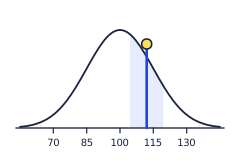
- Percentile
- 79
- Compared with adults aged 25 to 34
Choose a test
Head: reasoning and memory
IQ test
Reasoning with matrices, series, 3D figures and problems. IQ score with its interval.15 min20 questions
Giftedness test
The full IQ test with a report on the probability of scoring above 130.40 min20 + adaptive
Memory test
Memory for numbers and positions, forwards and backwards.10 min2 tasks
Heart: personality and emotions

Personality test (Big Five)
The five major traits, compared with people from your country.5 min25 questions
Introvert or extrovert test
Ten questions to see where you sit between introversion and extroversion.2 min10 questions
Emotional intelligence test
Seven aspects of how you notice, express and share emotions.8 min28 questions
Career interest test
Your Holland code (RIASEC) and the occupations that fit best.6 min24 activities
How it works
Choose a test
Reasoning or personality. Each one shows how long it takes and what it measures.Answer calmly
Four details to compare you fairly, then the questions, with a practice item before each block.Read your report
Your score, its margin of error and what it means, instantly and without signing up.
What a psychological test is
A psychological test is a standardised instrument: the same questions, scored the same way and compared with a reference group. That tells you not only how many answers you got right, but where you stand against other people.
There are two broad families. Performance tests such as the IQ test or the memory test have right answers and measure ability. Personality, interest and emotion questionnaires have no right or wrong answers: they describe stable tendencies.
What to expect from an online test
A good online test gives a useful, quick estimate, but it is not a diagnosis. That is why Animi always shows the margin of error, cites where questions and norms come from, and explains when a professional assessment makes sense.
To understand the ideas behind the scores, start with the guides on average IQ, the IQ scale or emotional intelligence.
The science behind our online psychology tests
| Test | Instrument | Authors | Comparison |
|---|---|---|---|
| IQ test | Open Matrices Item Bank with item response theory | Koch et al. (2022) | Adults by age, mean 100 |
| Memory test | Digit span and Corsi blocks | Monaco et al. (2013) | Age norms |
| Personality test (Big Five) | IPIP Big-Five factor markers | Goldberg (1992) | 590,000 people, by country |
| Emotional intelligence test | IPIP emotional intelligence scales | Barchard (2001) | Eugene-Springfield Community Sample |
| Career interest test | Public-domain RIASEC markers | Armstrong, Allison and Rounds (2008) | 131,000 people |
Guides to understand your results
Average IQ
The average IQ in the US, UK and by age, and why it is 100.IQ scale
The IQ chart: what each score range means and how rare it is.IQ 130
The giftedness threshold: what 130 means and how rare it is.What is IQ?
What an IQ score measures, and what it does not.Emotional intelligence
The model, what the research says and how it is measured.Flynn effect
Why average IQ rose through the 20th century, and what now.
Frequently asked questions
Are the tests free?
Yes. Every test has a free part with an instant result and no sign-up. The full report is optional and a one-off payment.
Are online psychology tests reliable?
It depends on the test. Animi uses published, validated instruments, and every result shows its margin of error. They are for guidance, not a professional assessment.
What happens to my answers?
Your result is worked out in your browser. We never ask for your name or email.
Which test should I start with?
For reasoning ability, the IQ test. To understand yourself better, the Big Five personality test.